This paper is an extended version of our first KSI paper1, which I had previously discussed.
As the previous paper had earned an award for best paper at the conference, we were invited to prepare an extended version to submit to the IARIA journals.
So we set out to address the short comings of our first implementation of KSI and developed KSI 2.
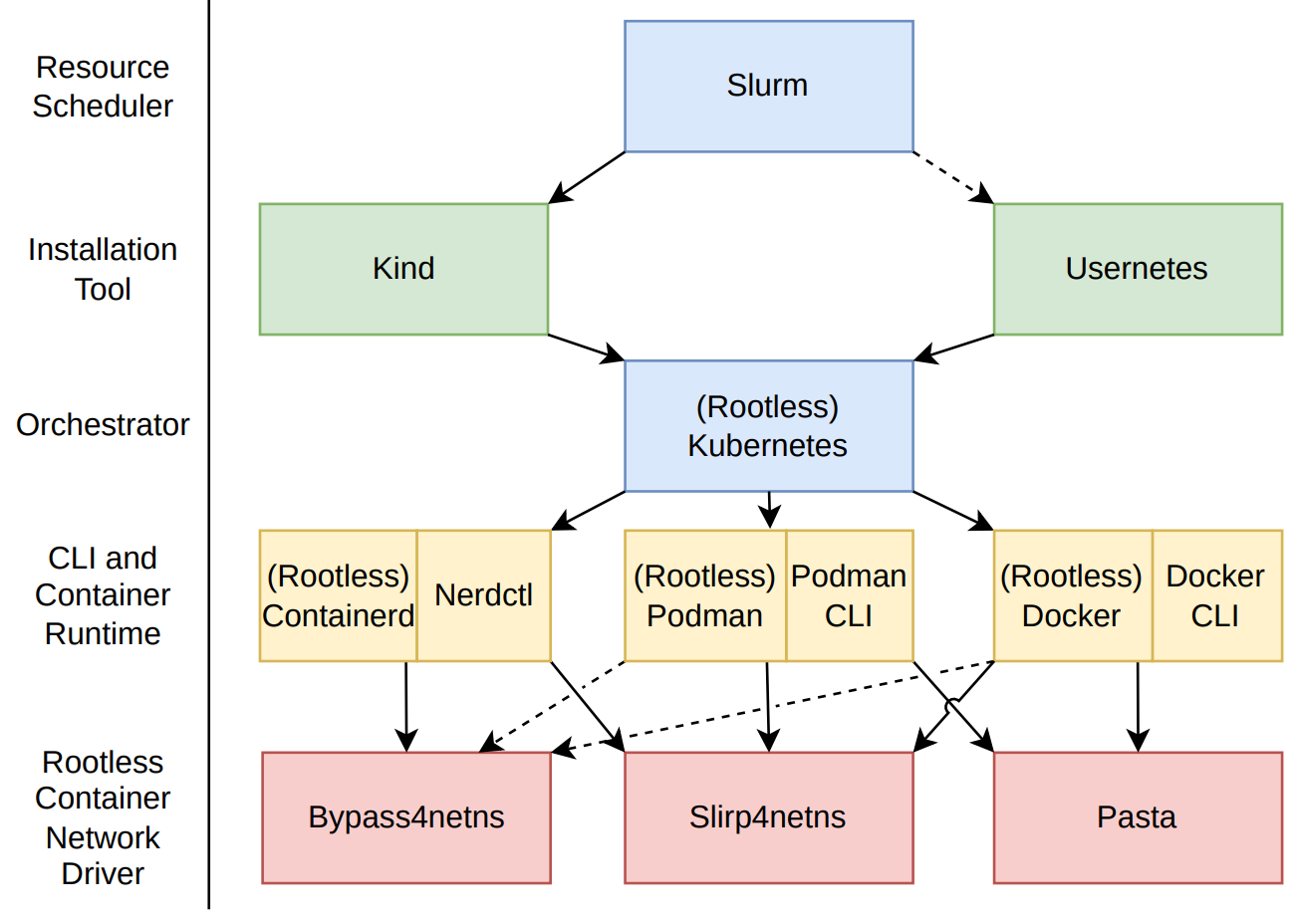
With KSI 2, we significantly improved the network throughput and enabled support for multi-node clusters such that it can now provide feature complete rootless Kubernetes clusters within Slurm jobs, without significant performance overhead.
We achieved this by replacing the previous rootless network driver, Slirp4netns, with Bypass4netns.
While this requires a more recent Linux kernel to be available on the host system, in our test we achieved throughput with 95% of the root network of the nodes.
The other change we made was to integrate Liqo, a tool for dynamically setting up multi-cluster Kubernetes environments.
So when deploying a multi-node Kubernetes cluster with KSI 2, it actually deploys a single node cluster on every node and then employs Liqo to aggregate them into a combined cluster.
The full details of our evaluation and the design can be found in the paper, which is available here: https://www.iariajournals.org/intelligent_systems/tocv18n34.html
-
Jonathan Decker, Sören Metje, Julian Kunkel, (2025), “Running Kubernetes Workloads on Rootless HPC Systems Using Slurm”, CLOUD COMPUTING 2025, [Link to article]. ↩
Related Posts
About Me

Dr. Jonathan Decker
Jonathan Decker takes the role of a system architect with a focus on designing systems that enable new and novel ways of utilizing Cloud and HPC resources, while also being efficient, secure and scalable.
Most notably, he strives to combine HPC with Kubernetes to get the best of both worlds.
Jonathan completed his PhD in 2025 via his work on Chat AI and its underlying AI inference platform, which now enables secure and sensitive access to AI services for students and researchers across Germany.
Moreover, in 2025, he served as the speaker of the PhD student representatives of the Georg-August-University of Göttingen.
Now he heads a team in the High-Performance Storage research group of Prof Kunkel while being in close collaboration with the GWDG.
There he handles research, supervision of PhD students and university teaching activities.