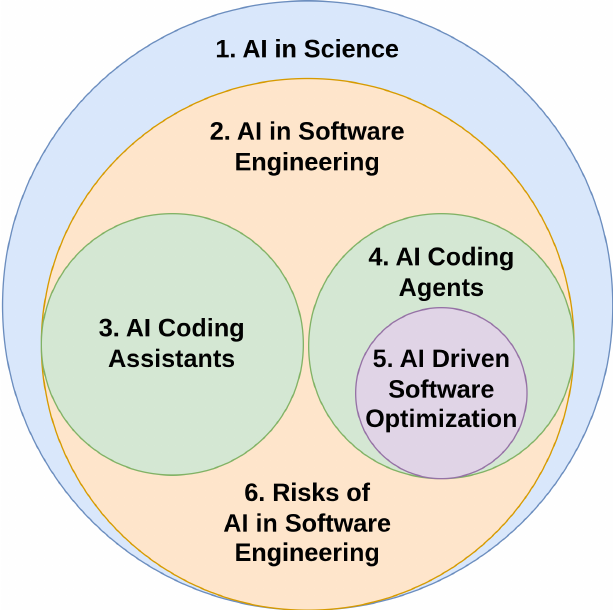
The rise of AI and it becoming ubiquitous in both research and industry has both advantages and disadvantages, which lead to long term improvements but also to potential problems if said disadvantages are not properly handled.
At the OpenFOAM Stammtisch 2026 I was invited to give a talk on the status of AI in research and in software engineering.
While preparing this talk I found that despite initial skepticism, AI is being employed more and more by scientists.
Mostly for administrative tasks but also for research.
Scientific software plays a special role here as it shares the same toolset as industrial software development and stands to benefit from advancements in AI tooling.
In the talk I distinguish between AI coding assistants that provide auto complete or chat functions to generate code snippets, and AI coding agents that given a task will continuously operate on top of a code bases, invoking an LLM over and over.
While these tools, especially AI coding agents, make the creation of new code extremely cheap, they also require more careful checking for bugs or security issues in the code.
Moreover, junior developers may fail to learn important basic coding skills as they hand over their work to AI to the point that they do not develop the skills to understand the generated code.
The full slides of the talk can be found here: Slides
Related Posts
About Me

Dr. Jonathan Decker
Jonathan Decker takes the role of a system architect with a focus on designing systems that enable new and novel ways of utilizing Cloud and HPC resources, while also being efficient, secure and scalable.
Most notably, he strives to combine HPC with Kubernetes to get the best of both worlds.
Jonathan completed his PhD in 2025 via his work on Chat AI and its underlying AI inference platform, which now enables secure and sensitive access to AI services for students and researchers across Germany.
Moreover, in 2025, he served as the speaker of the PhD student representatives of the Georg-August-University of Göttingen.
Now he heads a team in the High-Performance Storage research group of Prof Kunkel while being in close collaboration with the GWDG.
There he handles research, supervision of PhD students and university teaching activities.